The harkis in Algeria: continued taboo and controversy

In this post, Prof Margaret Majumdar, explores the controversy surrounding Pierre Daum’s new book on the harkis.

The recent publication of Pierre Daum’s book, Le Dernier Tabou. Les « harkis » restés en Algérie après l’indépendance (Actes Sud, Arles, 2015) has caused something of a stir in Algeria. Harki is a generic label for various categories of people who worked with the French army during the Algerian War. Looking at some of their individual experiences, it attempts to challenge accepted versions of history which claim that the majority of harkis, who did not leave for France at the end of the Algerian War, were abandoned to their fate by the departing French and subjected to summary justice and execution. It is based on a series of interviews with around sixty former harkis, living in various parts of Algeria today. Through this lens, it aims to show that many, after detention and questioning, for shorter or longer periods, were able to return to their home villages and resume their life, though not without suffering some ongoing discrimination as a result of their wartime activities.
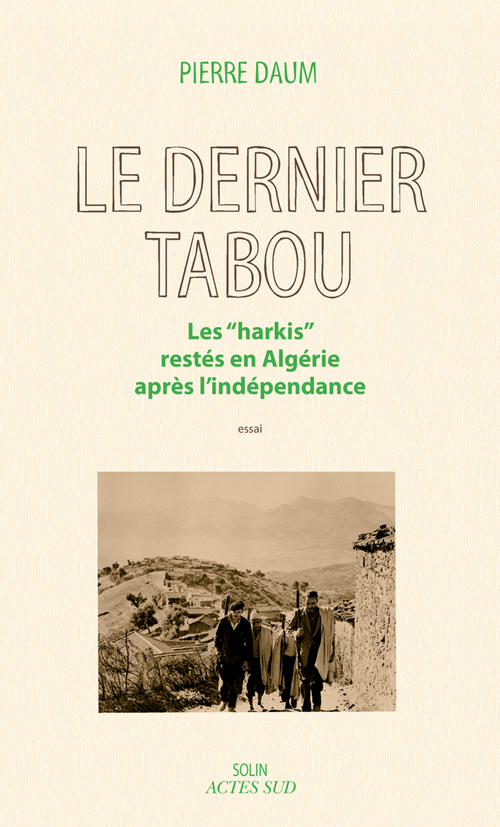
LE DERNIER TABOU

The reception of the book so far demonstrates that this question relating the harkis is still a controversial one. The time and the circumstances have not yet come when it can be treated with objective detachment. A clear example of this is the way in which Algerian Minister for Moudjahidine, Tayeb Zitouni, has disputed the facts and figures presented by Daum as foreign speculation. Not only has the fate of the harkis been grist to the mill of the diehard supporters of Algérie française, but also their very existence has been something of a taboo for the Algerian nationalist establishment.

For more on the controversy relating to Daum’s new book, see his article, ‘Enquête sur ces harkis restés en Algérie’, in Le Monde diplomatique April 2015. See also articles in El Watan, 27 March 2015 ; Liberté, 6 April 2015. Pierre Daum is a French journalist based in Montpellier with an interest in French colonial history. He has previously published on Indochinese workers in France and on pieds noirs who remained in Algeria after independence. He currently writes for Le Monde diplomatique.

A research visit to Benin: part 2

Following on from his recent post about the archives in Benin, Prof Tony Chafer shares some more practical advice on conducting researching in this West African country and provides an insight into one community-based development programme operating in the region.

I recently went to Benin for the first time for a research trip. The first principle of planning any such trip, for me, is to avoid large international hotels as far as possible. I don’t enjoy them, wherever they are: you could just as easily be in Singapore, or Abuja, or Johannesburg, or Dakar. You end up living in a bubble, isolated from the world around you. So the question was: where to stay? In Porto Novo smaller hotels appeared not to be on the internet, but a short browse revealed something called the Centre Songhai, which seemed to be a kind of alternative technology centre and which had simple rooms for rent at a reasonable price.

It proved to be an excellent choice. Not only was it convenient for the researcher – just a short walk from the National Archives and National Library – but it also provided a wonderful exemplar of self-help and community development. Founded by a monk thirty years ago, the Centre now occupies a 18-hectare site not far from the city centre. It grows crops, including rice and maize, produces vegetables from its market garden and has its own seed nursery. It also grows fruit and nut trees; has cattle and poultry, and a fish farm, and also produces energy on site. The emphasis is on using local resources, so that as far as possible everything, from the fence posts to the fertiliser (collected from the animal waste), is produced on site. Unlike many development initiatives, however, the Centre also processes and packs the food it produces, rather than simply focusing on the primary products. Manufacturing plants are dotted around the site, doing everything from packing the nuts, processing the fruit into marmalades and jams, processing and packing the rice, to using the waste plastic to manufacture feed buckets for the animals. In addition, the Centre has its own marketing, logistics and distribution sections. The Centre therefore benefits from the added value of all of these activities. Perhaps most impressive of all, however: it is not just a model for what community-based development can look like, it is committed to training. At any one time there are over a hundred young people aged 18-35 undertaking work-based training on the site. Over two and a half years they receive training in all aspects of the Centre’s work, from growing the crops and tending the animals to distribution and marketing. The Centre also takes people for shorter stages (work experience placements) of one to two weeks, to introduce them to specific aspects of the Centre’s work. At the end of their training, students receive a diploma.

The Songhai Centre now has ten sites, eight across Benin and two in neighbouring Nigeria. If you are interested in finding out more about its work, visit their website.