Fully Funded Arts and Humanities Research Council Collaborative PhD Studentship English in Algeria: Interdisciplinary Perspective

University of Portsmouth School of Languages and Area Studies with the British Council, Algiers

Application deadline: Friday 1 May 2015

Interviews expected w/b 18 May 2015

Start date: 1 October 2015

Project description

This studentship presents a unique opportunity to complete a PhD in an emerging research area and develop highly transferable skills by working both within a university environment and as part of a non-academic international organisation. The studentship project examines the place of English within the contemporary Algerian linguistic and cultural landscape. It explores the historical, political, economic and social contexts which shape learners’ motivation to study English, identifying new directions in research into shifts in global connections and perceptions of what has traditionally been termed ‘Francophone Africa’. It also seeks to provide the basis for more research-informed policy-making, enabling the British Council to better focus its work encouraging UK-Algerian co-operation and partnership, including study in the UK, and better direct its English provision for both students and teachers.

Applications for this studentship are welcome from anyone with a strong academic track record EITHER in the field of language and linguistics (especially educational psychology, applied linguistics or language teaching) OR in the field of Algerian or North African area studies (history, politics, cultures or society). Candidates are not expected to demonstrate competency in both fields at interview stage, but are expected to develop their knowledge of the field with which they are less familiar in the course of year 1 of the PhD, under the supervisory team’s guidance. Candidates must have a strong interest in the project and an ability to engage with and work across institutions. In year 2, the student will primarily be based in Algeria, carrying out fieldwork and acquiring workplace training working alongside staff in the English Higher Education Programme at the British Council.

The student will be jointly supervised by the University of Portsmouth and the British Council in Algiers. The academic supervisory team are all members of the School of Languages and Area Studies (SLAS), one of the largest departments of its kind in the UK, and the Centre for European and International Studies Research (CEISR). CEISR focuses on fostering, through its cluster-based structure, cross-faculty research across the humanities and social sciences. This project brings together the Francophone Africa and Language across Borders clusters, both of which have well established and internationally recognised research track records. The British Council has more than 75 years experience in promoting the English language and cultural relations in more than 100 countries around the world. The successful candidate will benefit from an extensive programme of research training and workplace experience, developing skills in intercultural awareness, project management and effective communication.

Eligibility

AHRC terms and conditions mean that to be eligible for this award, candidates must meet certain UK residency requirements: http://www.rcuk.ac.uk/RCUK-prod/assets/documents/documents/TermsConditionsTrainingGrants.pdf

Funding

This is a 3-year studentship which covers PhD registration fees, an annual AHRC maintenance payment (£14,413 in 2014/15), plus an additional £1000 per annum paid by the British Council.

Informal enquiries contact details

Dr Natalya Vince, Senior Lecturer in North African and French Studies, Natalya.vince@port.ac.uk and Dr Mark Wyatt, Senior Lecturer in English Language and Linguistics mark.wyatt@port.ac.uk

How to apply

Full details about the project and how to apply are available here: http://www.port.ac.uk/faculty-of-humanities-and-social-sciences/courses/ahrc-studentship-english-in-algeria/

“Crossing boundaries in the study of France and Africa”: study half day report

On Wednesday 18 February 2015, the Francophone Africa cluster at the University of Portsmouth held a study day exploring the theme of “Crossing boundaries in the study of France and Africa”. This half day event, which included papers from scholars based at the University of Portsmouth and institutions in the UK, France and Germany, was aimed especially at second year students in the Faculty of Humanities and Social Sciences registered on the “Guns, glory hunters and greed: European colonisation in Africa” unit, but was also attended by other students and staff from across the Faculty.

IMG_2066Joanna Warson introduces the study day, before Romain Tiquet’s paper forced labour in Senegal

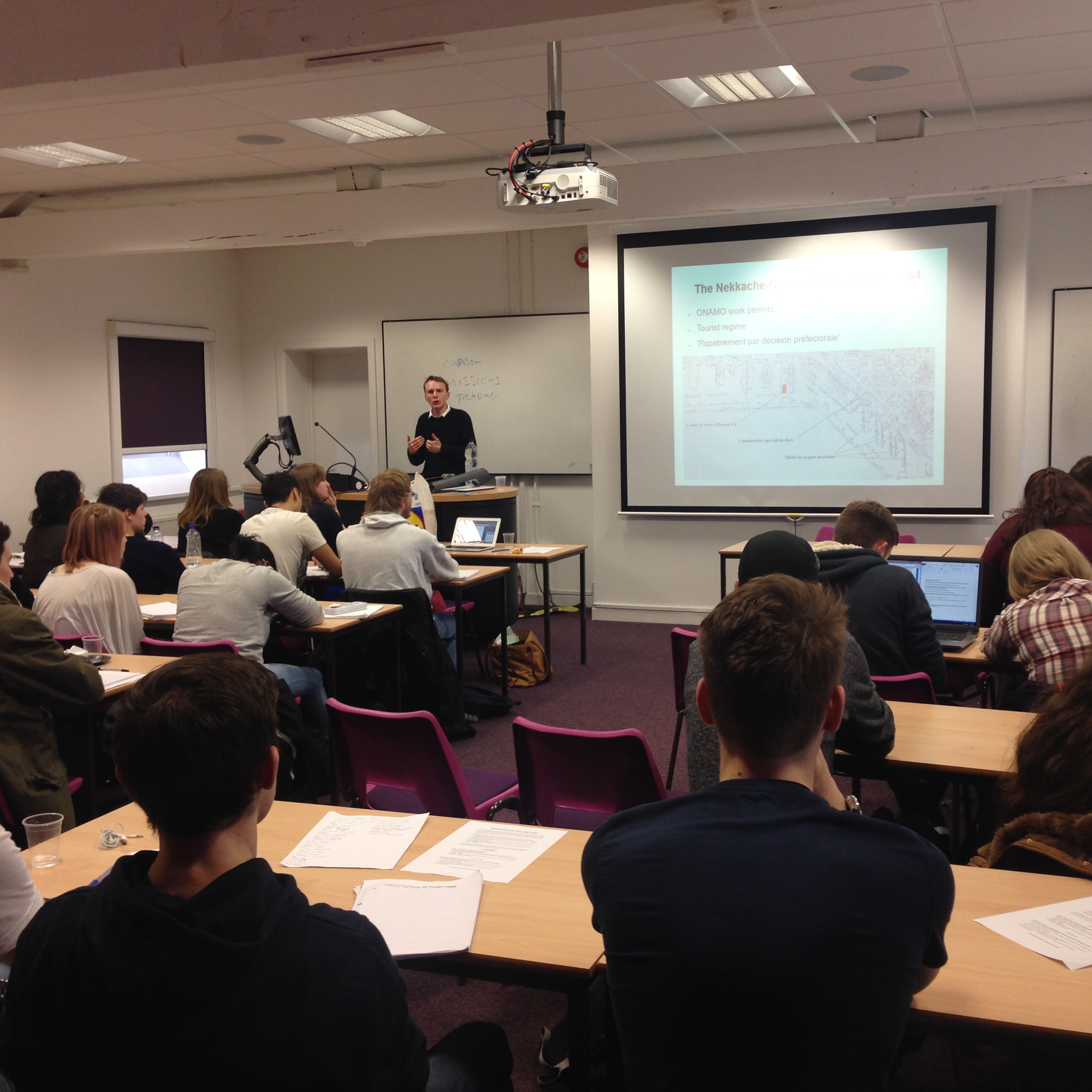
Joanna Warson (Portsmouth) opened the event with a brief introduction to the themes and aims of the event, emphasising especially the importance of adopting a broad perspective when studying relations between France and Africa. The first panel, chaired by Fabienne Chamelot (Portsmouth), focused on the theme of labour and detention. In the first paper, entitled ‘From the civilisation by work to the law of work: political economy and coercive methods of recruitment in (post)colonial Senegal, 1920s – 1960s’, Romain Tiquet (Humboldt) explored the use of forced labour in Senegal. Romain emphasised the importance of the practice for the maintenance of French rule in the region, as well as the ways in which its use was adapted over time. A key argument in Romain’s paper was the continuities, particularly in terms of the rhetoric surrounding forced labour, across perceived chronological divides – such as the 1946 Houphouet-Boigny law abolishing forced labour and Senegalese independence of 1960. The question of continuities between the colonial and post-colonial periods also featured in Ed Naylor’s (Portsmouth) paper on ‘“La salle des Africains”: Immigrant detention in Marseille during the 1960s and 1970s’. Ed addressed how colonial ideas and practices, such as notions of second class citizenship, the by-passing of legal procedures, and the gap between law and practice, were reproduced at ARENC, an immigrant detention centre, which opened in Marseille in the early 1960s to deal with the growing number of immigrants in France, particularly from the former French colony of Algeria. Ed also explored how ARENC provided a precedent and legal framework for France’s approach to immigrant detention, demonstrating how ideas from the colonial period traversed not only the divide between the pre- and post-independence eras but also continue to have legacies for the present day.

IMG_2039Ed Naylor speaks about immigrant detention in Marseille during the 1960s and 1970s

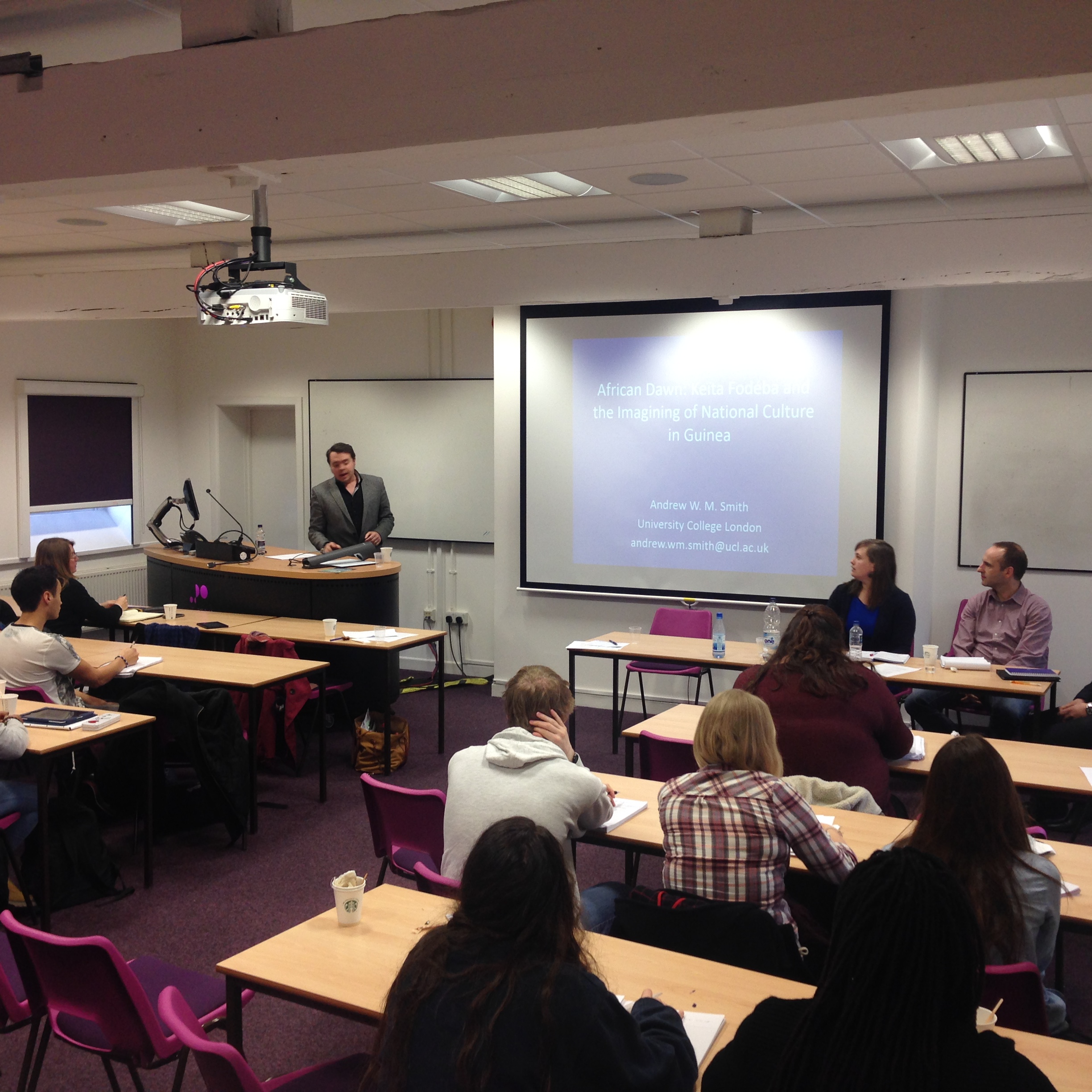
After a short break for tea and homemade cake, the second panel, chaired by Kelsey Suggitt, continued to probe the conference theme, with an exploration of different challenges to geographical and chronological divides in the study of France and Africa. Andrew W M Smith (UCL) opened the panel, with a paper entitled ‘African Dawn: Keïta Fodéba and the imagining of national culture in Guinea’. In this paper, Andrew presented the life and work of this Guinean musician, exploring the transnational development, reception and impact of Fodéba’s writings and music, as well as his role as a representative of the post-independence Guinean government. Through the lens of Fodéba, Andrew demonstrated the important part played by cultural elites in the defining and negotiating of national identity in the era of decolonisation. Roel van der Velde (Portsmouth) moved the geographical focus away from Francophone Africa, with his paper on ‘Crossing borders: French arms trade and South African military strategy, 1955-1970’. Through his exploration of the nature of, and motivations underpinning, Franco-South African military relations, Roel demonstrated the importance of breaking free from a uniquely Francophone focus when exploring France’s presence on the African continent. The panel concluded with a paper on ‘The Franc zone: a successful monetary decolonisation?’ from Vincent Duchaussoy (Rouen/ Glasgow). Vincent began by providing a brief explanation of the Franc Zone, before exploring how and why the system has been maintained after 1960. In particular, Vincent emphasised the importance of the Franc Zone as a source of financial stability in times of uncertainty, as well as the Africanisation of the system.

IMG_2042Andrew W M Smith presents his research on Keïta Fodéba and the imagining of national culture in Guinea

We would like to thank everyone who participated in this study half day for their excellent papers and interventions, which brought to light the multiple possibilities available to scholars of France and Africa by crossing boundaries. We would also like to thank the Centre of European and International Studies Research and the School of Languages and Area Studies for generously supporting this event.